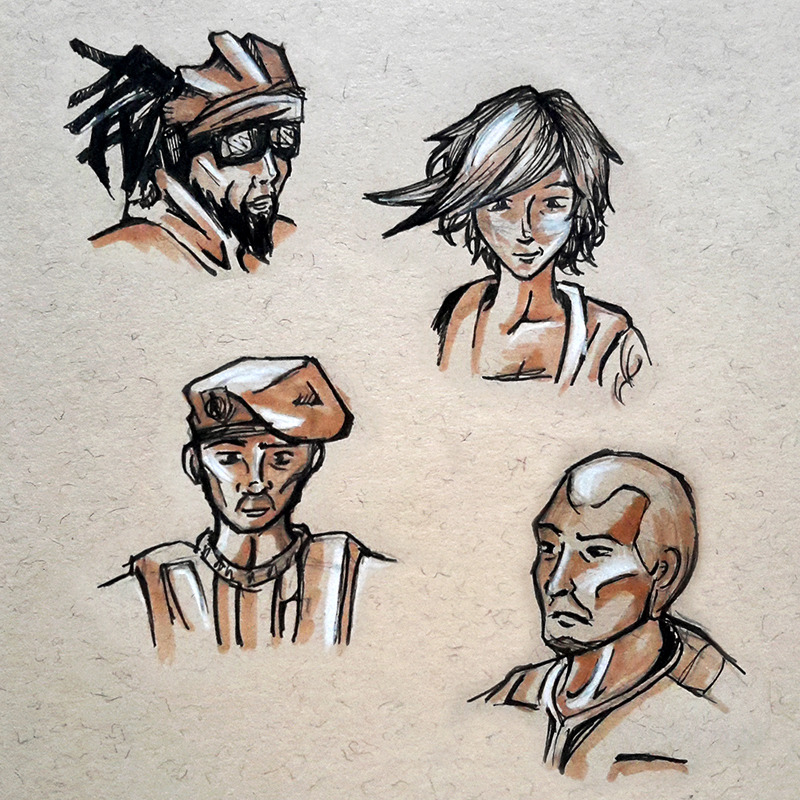
BL1 Vault Hunting Team as of the second game appearances mostly
Drawn without any references really so might be inaccuracies
another realisation about saiyuki: this is probably what prepared me for getting into borderlands isnt it?
the flip side of
other people taking jewish created symbols of anti-nazism (like
captain america) and making them…well even just not a symbol of
that rather than explicitly a symbol of the opposite, is what marvel
has been doing for ages (and what fandom does) which is taking the
things jewish creators were using to symbolise nazism itself and
making them not about that – diluting it down to some kind of
ambiguity or just flat out erasing it whichever. That also damages that important anti-nazi message in the work you’re doing it to.
Its part of the same
thing. Portraying explicitly nazi-symbolising characters as not nazis
should never be a thing you consider okay and to see people protest
cap being hydra and then also do this shows very clearly it is not
the antisemitism that bothers you in this situation and that you just
flat out dont get it.
So, Thatcher was the bane of the working classes, and much of what she did still has repercussions to this day. So, in no particular order, just in the order I remember them, here are some things she did that pissed us off –
•
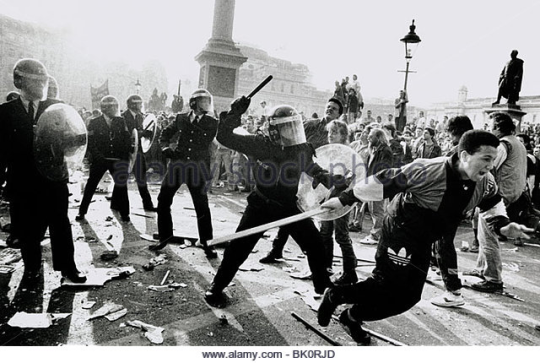
In 1989 she introduced this thing called the “Community Charge” but which everyone calls the “Poll Tax” which replaced an older system in which your tax payment was based on the rental value of your home. This new tax meant that people living in one bedroom flats would pay the same as a billionaire living in a mansion. Obviously, the rich loved it, everyone else… not so much. So there were riots (video of news about the riots) – There were lots of riots in the Thatcher years, and they were all notable for the extreme levels of police brutality.
(photo, poll tax protest in Trafalgar Square, 1990)
•
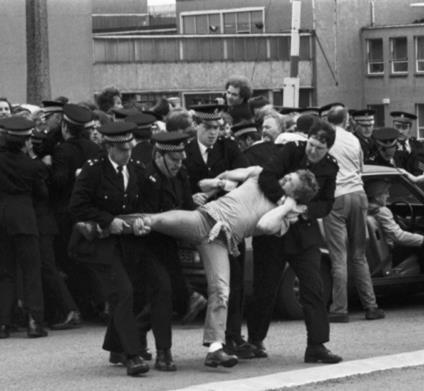
Then there was her war on industry. There was a lot of inflation when she came to power, so she instituted anti-inflationary measures. All well and good… except not the way she did it. She closed many government controlled industries, most famously steel and coal. The amount spent on public industries dropped by 38% under Thatcher. The coal miners went on strike, for almost a year, but in the end, the pits were still closed, and 64,000 people lost their jobs. Unemployment rates soared in industrial areas, and inequality between these (generally northern or welsh) areas and the rest of the UK is still there. During the strike there were numerous violent clashes with the police at picket lines which were widely televised. As a memoir from one miner attests: “
I saw a police officer with a fire extinguisher in his hand, bashing a lad in the back. I tried to get closer to note down the officer’s number but they were wearing black boilersuits with no numbers. The next thing I knew, a police officer struck me from behind. I was coming in and out of consciousness as I was dragged across the road into an alleyway. They blocked off the alley and beat another lad and me with sticks until I was unconscious.” (I can’t post the whole thing it’s too long, but read it in the Guardian) Images such as this swept the country, turning many people against Thatcher –
And after it was all over people felt Thatcher had lied, saying she wanted to close only 20 pits, when in the end, 75 were closed down.
• Inequality soared whilst she was prime minister. There is a thing called the gini coefficient, it is the most common method of measuring inequality. Under gini, a score of one would be a completely unequal society; zero would be completely equal. Britain’s gini score went up from 0.253 to 0.339 by the time Thatcher resigned.
•
During her time as prime minister the notorious ‘Section 28′ was published. It stated: A local authority shall not (a) intentionally promote homosexuality or publish material with the intention of promoting homosexuality; (b) promote the teaching in any maintained school of the acceptability of homosexuality as a pretended family relationship. – Section 28 wasn’t repealed until 2003.
• She introduced the Right To Buy scheme, which allowed people to buy their council houses for a very low price, which, at first glance, seems like a great idea, allowing people who normally wouldn’t be able to afford their own home to have one – however, loads of people have entered the scheme and now we have far too little social housing, meaning there has been a sharp rise in homelessness.
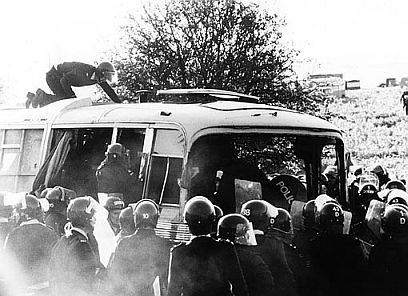
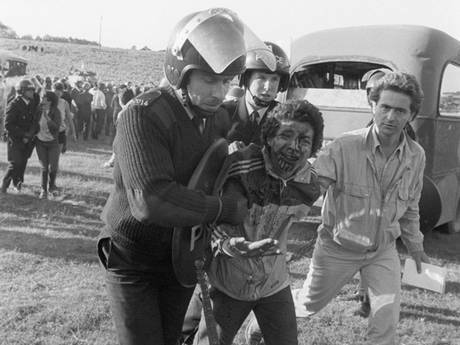
• The Battle of the Beanfield was a clash between hippies and police near Stonehenge in 1985. 1300 police officers converged on a convoy of 600 new age travellers who were heading to Stonehenge to set up a free festival in violation of a high court order. Again, there was an insane amount of police brutality, and 16 travellers were hospitalised, 573 people were arrested (one of the biggest mass arrests in UK history) – “Pregnant women were clubbed with truncheons, as were those holding babies. The journalist Nick Davies, then working for The Observer, saw the violence. ‘They were like flies around rotten meat,’ he wrote, ‘and there was no question of trying to make a lawful arrest. They crawled all over, truncheons flailing, hitting anybody they could reach. It was extremely violent and very sickening.’” (source) – Once everyone was arrested, the empty vehicles, which were in many cases the only homes the travellers had “were then systematically smashed to pieces and several were set on fire. Seven healthy dogs belonging to the Travellers were put down by officers from the RSPCA.” (source same as above)
Most of the charges were dismissed in court after Lord Cardigan, who had tagged along with them to see what would happen, testified on behalf of the travellers against the police.
•
Her removal of Irish dissidents right to be placed in a category that essentially made them political prisoners instead of merely criminals led to a hunger strike that ended in 10 deaths, including that of Bobby Sands, who was elected from his prison cell, reflecting the immense national, and international support for Irish nationalists. Thatchers lack of sympathy, or even empathy led to her becoming even more of a hate figure.
• She presided over a rapid deregulation of the banks, which ultimately led to much of the problems during britains 2007-2012 financial crash many years later.
• She took free milk from school children, which, though not as serious as anything else listed here, directly affected every child in the UK and was very unpopular, leading her to get the nickname “Maggie Thatcher, Milk Snatcher”, which is still used today.
This is nowhere near everything she’s done that pisses people off, but I hope it goes some way to explaining why when she died “ding dong the witch is dead” became number one in the UK charts, people partied in the streets, and people protested her (State funded) funeral. She is a decisive figure, some people in the UK do actually love her. I do not. She decimated the UK’s industrial heartland, she caused mass unemployment and the destruction of much of working class culture, she was cavalier in her financial policies and increased inequality by staggering levels, she approved serious police brutality and attempted to destroy the culture of unions in this country. I fundamentally disagree with all she stood for and it angers me that her mistakes are still affecting this country and the people who live in it. And I am VERY angry that the current government are spending £50 million on a museum about her.
Regarding selling off social housing, it was specifically that the income that local authorities generated from doing so was not allowed to be reinvested in acquiring new social housing. And no extra budget was allocated to cover building new social housing. The aim was clearly to create a social housing shortage as a twisted way of “motivating” people to stop being poor.
Great post. I hate seeing US feminists praising Thatcher, and I’ve seen it a lot.
edit: come of tumblr this is in paragraphs int he editor….
As far as I know the profits made from selling off social housing went to central government not local authority in the first place, but another part of this is where funding for social housing now comes from. Prior to Thatcher like 70%+ of architects worked for local authorities because public/social/civic building projects were funded by the councils, now about three councils employ architects like this – Thatcher (and later) privatised all this.
Now local authorities no longer control the money for these projects and it doesn’t come from the government. the funding for these kind of projects comes largely from the national lottery fund…they are less interested in building social housing or hospitals or schools in local areas than the local authority is. Partly they tend to build more showy things because they kind of have to for public interest to remain and partly its decided on a national level not local – so near everything gets built in london.
Essentially she sold off social housing and set up a system where we still can’t get more of it built today. In addition to there being less social housing by directly selling it right to buy is a leading cause for gentrification near everywhere it happened (and particularly large swaths of London) in addition to homelessness. Or rather before this councils could ensure that gentrification had no effect on the housing in the area (by essentailly owning most of it) and now they can’t. //
Essentially the answer to ‘how does this piss people off for so long’ is its either still happening or still having an effect
The extension of right to buy (to housing association tennants) by this current government also really doesn’t help – they are (alledgely) going to fund the building of replacement homes for those sold (which is money local councils have to raise…by selling off empty council houses) which they insist will not reduce the number of affordable homes across England – which might be true, providing those replacements do actually get built, but it will reduce the amount of affordable housing in certain areas – cause those replacements will have to be built elsewhere (because that’s where there’s land to build on) – so people continuing to do the stuff she did while in government (also new labour…) Is also a problem
Pretty sure most of us are aware of the discontent with the flags in the aro community, so as an admin of the @aroagenda on twitter and an aromantic myself, I decided to put together something that meshes better with how I relate to aromanticism and the views/ideas/feelings I see commonly shared in the aro community. I’m not sure where the green/yellow came from, or who decided those should be “aromantic” colours, but to me, this feels like a closer relation to the aromantic spectrum. First, I realise that this flag has many shades, and that was the point. I have very rarely seen two people on the aromantic spectrum who share the exact same viewpoint. There are so many different categories of aromanticism and it’s important to acknowledge them all, so I will explain my colour choices.
Fuchsia: Pink is commonly related to romance, I know, so I chose fuchsia, a deeper pink with purple tones. This is for the akoiromantics, the cupioromantics, anyone who understands romantic attraction, desires romance, or otherwise relates to romance to a certain point, but is still on the aromantic spectrum. It’s important to acknowledge that not everyone on the aro spectrum is 100% aro and feels neutral towards romance.
Shades of Maroon: Including Burgundy and Tyrian purple, the middle part of the flag represents the greyromantics, the demiromantics, the quoiromantics, anyone on the aroflux spectrum, anyone who feels a connection to aromanticism but isn’t sure where they stand. (e.g. those who can’t define romantic attraction) These colours (the brown tones) represent security and stability, for those seeking it, along with ambition and dignified action. These are strong-willed colours and represent characteristics I often see within the aro community (and queer community as a whole). Too often aromantics are depicted as cold and unfeeling, along with affection being equated to romance and all forms of love being watered down into only romantic love, giving off the idea that people on the aromantic spectrum aren’t capable of love. I’m not going to comment on the sheer absurdity of that, only showing that our flag can be warm and vivid; giving off the passion and love we are capable of, while still retaining meaningful aspects of aromanticism. Which brings us to,
Indigo: This end of the spectrum represents the fully aromantic. This is for the people who are too often misrepresented and wrongly stereotyped, reduced to dispassionate, aloof robots and have the desire to rewrite that image. Indigo reflects great devotion, wisdom and justice along with fairness and impartiality. It is a defender of people’s rights to the end.
So far, there are two abbreviated versions:
and
Please let me know if you like the design, have any feedback/questions, or want to add something!
I…can’t see the colours, or rather I can’t see the differences between the colours. so, as such, not particularly keen.
(also i think its too dark but who knows, that could be entirely different if you can see it properly. And pride flags tend to have horizontal stripes so thats slightly disconcerting but is probably a case of getting used to the visual)
i did the getting snapchat thing!
i have a bunhc more expo photos i’m just a bit snowed under so theres a break for a little while
Chefchaouen, a small town in northern Morocco, has a rich history, beautiful natural surroundings and wonderful architecture, but what it’s most famous for are the striking and vivid blue walls of many of the buildings in its “old town” sector, or medina.
The maze-like medina sector, like those of most of the other towns in the area, features white-washed buildings with a fusion of Spanish and Moorish architecture. The brilliantly blue walls, however, seem to be unique to Chefchaouen. They are said to have been introduced to the town by Jewish refugees in 1930, who considered blue to symbolize the sky and heaven. The color caught on, and now many also believe that the blue walls serve to repel mosquitoes as well (mosquitoes dislike clear and moving water).
Whatever the reason, the town’s blue walls attract visitors who love to wander the town’s narrow streets and snap some beautiful photos.
good point, i quit my english AS cause of those essays due in January…
But then I didn’t take any essay subjects because of that reason so…
(and yeah I probably should have stressed out so much more last january, I would have done so much more revision xD) (which is kinda why I think it’s important to have those exams, so you get hit by the reality of how much work you really actually do have to do)
(but yeah essays over christmas sound horrid)
I deliberately avoided essay subjects for similar and additional reasons then ended up having to write one anyway in art of all things!
I mean i wrote it on comics but it was still anoying
(I am home safely just cant find phone charger in the bag at the moment incase anyones texted me later than about ten)


 fearlessstateofmind backup