ovw secret santa from twitter for @lizenzkreuz ! ❤❤❤ The prompt was mcgenji in ovw times? kinda… I think I just interpreted it like I wanted. and maybe it wasn’t that at all 💦💦💦
drew this from tonights stream to take a break from something else i was working on. just found out that genji has this dope ronin look from the halloween comic?? AND THERES NO SKIN FOR IT? overwatch PLEASE
I see blizzard are providing more evidence for my ‘at some point they decided skins were going to have different hairstyles and they’ve now run out of hairstyles that suit the character/look good at all’ theory this event
The Ray and Maria Stata Center (MIT) by Frank O.Gehry
Cambridge, Massachusetts, USA
The world’s most expensive pile of hideous garbage. Now with classrooms in it!
The Stata Center is an insult to the basic concept of architecture. If you could design a piece of art to personally offend an abstract concept, this would be it.
I have bitched about brutalism before, and I will do so again. But brutalism is supposed to be livable and pleasant for those in the building, and occasionally it even succeeds. The Stata Center is what happens when someone who wants to make symbolic art about confusion and unusability is accidentally permitted to make art out of people’s offices and classrooms.
It might sound like I’m exaggerating. I’m really not. There were some unplanned issues with Stata, like the failure to build in proper drainage or downslopes for snow. In Boston. Which got the developers sued. But those are minor problems compared to the intentional stuff.
This is the plan for floor seven of the Stata Center. See how it’s two completely distinct sections? Floors seven, eight, and nine are actually two distinct components, so walking from one end of nine to the other involves six flights of stairs. And even below that, well, here’s floor four. You know what description I’ve never wanted to give to an room? “Jagged.” But here’s Frank goddamn Gehry, designing two rooms with a combined total of twenty eight exterior walls.
I could go on, but I’ll restrain myself. The Stata Center is an interesting building. It’s just sort of a shame when exotic concept art happens on people’s living spaces instead of on canvas.
I’m not a real libertarian, but I still immediately thought “this is what spending other people’s mobey on other people’s buildings looks like”.
Also, could you point to some liveable brutalism? I’m a little doubtful about that.
Also, could you point to some liveable brutalism? I’m a little doubtful about that.
I really can’t… By “supposed to be livable and pleasant” I meant “when fans of brutalism praise it that’s what they keep telling me”. Well, first they tell me about its artistic and historical significance, and then when I say “but it’s not just a painting, some poor bastard has to live there”, then they tell me the “livable and pleasant for the inhabitants” bit.
I don’t find it especially accurate, but it’s still more noble than Stata, which is basically justified with “wouldn’t it be funny if I made people work in a literal maze?”
My experience with brutalism is that it’s more hostile to the actual inhabitants than it is to onlookers. I don’t actually object to it for the usual ‘eyesore’ reasons, I object to it because people keep making me use the damn buildings.
You nailed my impression with “spending other people’s money” – I think it’s reason brutalism is generally reserved for universities, schools, state houses, and train stations. They get to hire a big-name architect, receive lots of favorable press, and have your building featured in travel guides and Wikipedia. In return, the people who live there get to inhabit a grim box with disastrous energy efficiency, no natural light, wasted space, and no capacity for retrofitting or modification, which will need to be entirely torn down when the rebar rusts (and you won’t even know if that happened).
I’ll give brutalism a few passes for its age. The complete impenetrability for wifi and cell service isn’t something they could have foreseen, energy efficiency wasn’t on anyone’s mind, most of it was built before the rebar rusting issue was known, and most pre-2000 architecture failed to anticipate “everyone wants to have access to outlets anywhere they sit down”.
But it’s still true that brutalism is much less able to adjust to these changes than its contemporaries, and that’s not an accident. It’s high modernist ideology at its worst – buildings designed to impose on their surroundings, making practical decisions for ideological reasons, and refusing to concede any chance of needing modification down the line.
I feel a bit strongly here, obviously, and I ought to at least try answering the question.
I’m told the Barbican is actually quite nice, and Bradfield Hall is the least-bad brutalist structure I’ve lived in. It’s brick, so it’s not falling down, and it actually fits fairly nicely in its space. While it suffers the usual lack of light (the current Wiki page is apparently vandalized to say the inhabitants ‘despise’ it), ideology was at least welded to purpose – the windowless rooms are climate-controlled laboratories.
I think @anaisnein is a big brutalism fan, and might be kind enough to share a favorite example of a livable building?
I am abroad on my phone on shitty wifi so can’t find you a good residential example right now. I must say I generally like it best as a style for grand public spaces like museums. I will just say though, lack of light is absolutely not a universal or necessary characteristic of the style. You have experienced shitty brutalist architecture, which is atrocious. I only have like six pics total to choose from already sitting on my phone, but
Edited to add that Frank Gehry should be taken out back and summarily shot. That’s not brutalist, it’s pure bullshit wanking.
Yep, lack of natural light isn’t a universal feature.
I can’t share identifying details but my grandfather was a brutalist architect (broadly speaking) and designed & built a set of flats in the style which he then moved into with his young family, only leaving when there were too many children for the space. Their neighbours lived there for 50 years. How’s that for liveable?
(@thefutureoneandall@earnest-peer if this might help with finding a residential brutalist example) the building that was once described to me in a lecture as “a rare brutalist building that people actually like living in” is habitat 67 (the architect is Moshe Safdie) I’m not sure entirely how accurate that is – but I think it’s helped out by being a bit of a reaction against the extremely top down modernist design philosophy, it’s also relitively concious of being energy efficient at least for the time it’s built.
Park hill in Sheffield is one of the few largely(? Might be too strong) or at all successful retrofits/regenerations of a brutalist residential building – unfortunately not very applicable outside of that because park hill has features like ‘being structurally sound’ which are rare…
Sweden: “but dance off I guess”
Trying out some things + I’ve never posted anything with Sombra before
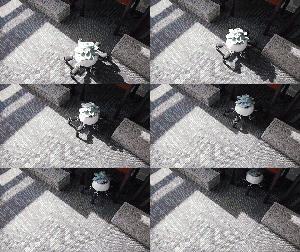
This adorable little robot is designed to make sure its photosynthesising passenger is well taken care of. It moves towards brighter light if it needs, or hides in the shade to keep cool. When in the light, it rotates to make sure the plant gets plenty of illumination. It even likes to play with humans.
Oh, and apparently, it gets antsy when it’s thirsty.
The robot is actually an art project called “Sharing Human Technology with Plants” by a roboticist named Sun Tianqi. It’s made from a modified version of a Vincross HEXA robot, and in his own words, its purpose is “to explore the relationship between living beings and robots.”
From “A Clash of Kings”, an essay discussing perspective, unreliable narrators, “you the player” as an interactive storytelling element, and the motivations of Doomfist and Reaper.
“Which brings me…to ‘Perspective.’ One of the things we really like doing with Overwatch is playing with perspective. We utilize perspective when we analyze or when we tell stories about characters, what they’re thinking, what their goals are. And we have a lot of unreliable narrators. We want people to pay careful attention to what characters think about in particular situations. We want them to use their judgment and their knowledge of a character’s thoughts to come up with their own ideas about the universe.
“You the reader” or “You the audience” or “You the player” are not just a simple “witness” of these character interactions, or these events, or these stories. In nearly all of the shorts, comics, and events, “You the (blank)” are your own, separate, individual perspective.
And Overwatch “the larger story” knows that.
And plays upon it.
Reminder:
“Retribution” not only encourages you to explore all four “witness” perspective, but also engage reflexively with your own. This can be as varied as “so, how did hearing about McCree posing as a waiter make you feel?” to
“Which perspective do you trust? And why?”
Moira’s Origin video is deliberately designed to mislead you. Her Hero Profile – as all of the Hero Profiles – is specifically written to be vague enough to “guide your thinking” into the assumption that she joined Talon after she left Blackwatch. However, it is also just flexible enough to leave room for the interpretation that she was in Talon before she joined Blackwatch.
Hell, even the title of the event – “Retribution” – is a very deliberate play on words.
Is it Gabriel’s “Retribution” upon Talon, as the comic wants you to believe?
Or is it Moira’s retribution upon Blackwatch and Overwatch?
“We stand on the brink of a breakthrough in human evolution. I have dedicated my life to unraveling its secrets. I take risks that others would consider to be ‘unwise,’ for I do not share their caution. Overwatch held back the pace of scientific discovery for decades. They believed my methods were too radical… too controversial…
“And they tried…to silence me.
“…But there were others in the shadows, searching for ways to circumvent their rules. Freed from my shackles, the pace of our research hastened – together, we delved deeper into those areas forbidden by law, by morality…and by fear.
“New patrons emerged who possessed an appetite for my discoveries. And with this knowledge…what new world could we build?”
If you play “Retribution” again before this week is over, try ignoring McCree. The game wants you to believe his perspective. Just like “Searching”, it is actively trying to push you into following his “narration” of the events leading up to it, the mission itself, and the events in the aftermath.
The game is playing on your perspective. It knows that you read the “Retribution” comic. It knows that you go into the “Venice mission” expecting Gabriel Reyes to be “a good guy.” It knows that what “you the player” are interested in is seeing how this character:
“Becomes” Reaper.
And it does everything in its power to make you believe McCree’s perspective. It changes the opening narration to McCree’s description of the events. In the “standard” version of “Retribution,” McCree’s voicelines are the ones most frequently activated, and they are furious with Reyes. It closes the “mission” with another McCree narration, which – just like Moira’s Origin video – is deliberately designed to make you doubt Gabriel Reyes’ intentions and perspective.
The game is trying to trick you.
It is using literary, visual, and interactive “sleight of hand” to draw your attention to McCree – his perspective, his emotions, his words, his “story” of the event – and away from Gabriel’s own perspective:
And from Moira’s more hidden, more “masked” perspective.
As I said, it is an ambitious – arguably too ambitious – attempt at interactive, perspective-based story-telling. There is no “reliable, third-person omniscient narrator” here to “tell you the full and utter truth.” Hell, not even Junkenstein’s Revenge is free from “unreliable narrators”, as Reinhardt (the man “narrating” the “story”) often interjects with his own perspective or sense of humor. The “player” is left alone, without direct narrative guidance, in a story mode that is actively trying to mislead them from building their own informed, critical, analytical perspective.
And Overwatch relishes that.
Overwatch wants you to believe McCree. It wants you to play Retribution and “get upset” with Gabriel. It wants you to feel like Gabriel has somehow betrayed Blackwatch’s or Overwatch’s ethics, or its “purpose”, or its…anything.
But Gabriel himself tells both McCree and “you the player” that he himself sees Retribution as him doing what he has always done.
Moira: You did what needed to be done, Gabriel. Don’t apologize. Gabriel: I never have, and I don’t intend to start now. Someone has to be the one to get things done.
McCree: Is this what we’ve become, Gabriel? Gabriel: Blackwatch has always had one purpose: to do the real work of keeping the world safe. I thought you had the stomach for it. Looks like I was wrong.
Because Overwatch wants “you the player” to feel like a “hero” – to feel like you are the protagonist of these characters’ stories. It wants you to participate and engage with the world, the events, the plotlines, and the literal “video game” action of it in a perspective-based way.
And yes –
This has been confirmed by the Principal Software Engineer of Overwatch:
We always knew that Retribution’s ‘A to B’ was going to be dictated almost entirely by the narrative, because we really wanted to bring players into this crucial moment in Overwatch history that we’ve only really alluded to before: exposure of Blackwatch, the rift between McCree and Reyes, and how Reyes goes from being a key member of Overwatch to the antagonist we now know as Reaper. The story was there, and the Blackwatch characters were there. And crucially, the flow of the mission—this extended street fight where you’re trying to escape a city while all these enemies are trying to kill you—was there, too. That said, we realized we’d put ourselves into a tough spot: the Blackwatch team was three offense characters and a single support.
Our job was clear: since we had so many offense heroes, we had to make extra sure that the enemies we designed were fun to kill.
We made a ton of small but very deliberate choices like that in Retribution. As a designer, it’s easy to have mixed feelings talking about this kind of stuff—it sort of feels like you’re revealing a magic trick. Even when a moment is engineered, we want players want to feel like they discovered something on their own, because that’s when you feel the most badass—most like a hero.
I feel like the other (er….) Narative purpose (?) Of Mccree’s perspective/a lot of his dialogue is to repeatedly go “something is very wrong” at the viewer? Then because the viewer has more information than he does the viewer also knows he’s wrong about what that something is, but it’s to make you question and then be more critical of the new things you hear on subsequent playthroughs, maybe?
Because without him what you get is; Gabriel going “this is buisness as usual” or at least “this is the next logical step in buisness as usual”; Genji, who has less context, going “sure okay if you say so” essentially serving as the neutral perspective – almost to the point of apathy as Genji is not in a good place – (alternatively Genji has the most realistic viewpoint of anyone, that walking into countries where you don’t have jurisdiction and killing people pretty much has the same effect whether you initially planned to do so or not and thats not an important detail); and Moira who falls somewhere between supportive of Gabriel and blatently suspicious depending on how charitable we’re being – but also she has a line that agrees with McCree that this is actually a departure (she’s just way happier about it).
While Gabriel has a lot of lines indicating that he considers this to be what he/they have always done, McCree has a lot of lines telling us that he doesn’t. Given there’s no way McCree has just misinterpreted what blackwatch and he himself do for 12 years that still leaves several options; one of them is lieing (nearly definitely Gabriel – McCree doesn’t really have a reason to?), They disagree about what the next logical step in what they’ve always done is (to the tune of “we have to start executing people” “uh…no? We don’t?”) Or this is always what Gabriel has done it’s just not something the rest of blackwatch has actually been involved with/witness to.
Basically Gabriel and Moira spend most of the mission going “this is fine, nothing is wrong, this is normal” and McCree spends it going “this is not fine, things are very wrong, this is not normal”. Even without McCree’s voice here the player probably has enough information to work out it isn’t all as normal (but it’s way more open to the interpritation it is) but with it if the player isn’t going “huh something seems a bit off” they maybe aren’t paying enough attention.
Overwatch finally gave me legendaries this event, it even gave me two in one box and then that turned out to be coins and McCree’s super whitewashed one 😦



















 fearlessstateofmind backup